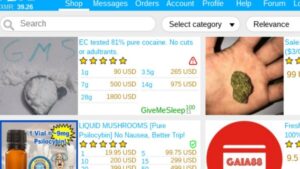
Shortly after the Silk Road darknet market took off, Bitcoin reached $266 per coin, and the Silk Road marketplace became a $200 million operation. Before the Silk Road marketplace, Bitcoin was mainly a novelty, with the first Bitcoin transaction famously being 10,000 BTC for 2 pizzas. Silk Road proved the market for secure anonymous transactions based on blockchain ledgers, and the viability of cryptocurrency in general. The Silk Road website was an anonymous internet marketplace active from January 2011 to October 2013. Learn all about Silk Road’s rise and fall and the dark web marketplaces that replaced it. As the internet’s first widely used dark web market, Silk Road has a wild and seedy history, and it played a significant role in the emergence of Bitcoin.
What Is The Legacy Of The Silk Road In Terms Of Online Black Markets?
The site’s use of Tor and other technologies made it difficult for law enforcement to track down the site’s operators and users. The site’s success opened the door for other similar marketplaces to emerge, offering a wide range of illegal goods and services. Silk Road had a significant impact on the world of online marketplaces and the dark web. His vision was to create a modern-day marketplace where people could buy anything anonymously, with no trail whatsoever leading back to them. At the same time, he acknowledged that at least six people named by prosecutors had in fact overdosed and died from Silk Road narcotics.
- During his trial, Ulbricht’s defense also pointed to evidence that he advocated for “safer” drug use on Silk Road.
- The son of Kirk and Lyn Ulbricht, Ross has a sister, Cally, who was residing in Australia at the time of his arrest, and a half-brother, Travis.
- It’s easy to imagine the Dark Web as populated solely by villainous hackers and drug lords.
- As Silk Road became a true global market, DPR reveled in his role as leader and libertarian evangelist.
- Prosecutors framed him as a cold-blooded mastermind who not only facilitated drug deals but allegedly attempted to commission murders to protect his empire.
- Ulbricht, 40, was convicted of seven counts related to his operation of Silk Road, which facilitated the sale of illegal drugs and other illicit goods using Bitcoin, including distributing narcotics and engaging in a criminal enterprise.
He hid it on Tor (The Onion Router), a browser system invented by the Navy that relies on layers of computer routers and is now used by dissidents, drug sellers and pornographers to cloak their Web activities. Ulbricht's girlfriend and Bates were the only people he told about his project. The stunning rise and sudden fall of Silk Road is a story so compelling it was optioned by Hollywood before Ulbricht was convicted. He fashioned himself a libertarian, perhaps a younger, hipper version of Mitt Romney in his early days at Bain Capital. He is ambitious, creative, tech-savvy and a dead-ringer for actor Robert Pattinson.
Why Trump Freed Ross Ulbricht, The Silk Road’s Dread Pirate Roberts
“I want to have a substantial positive impact on the future of humanity by the time I die,” Ross says. The first time they’d hung out, they did psychedelics, something called AMT. There was the time the two of them tried to steal extra Tater Tots in the lunch room at West Ridge Middle School. Ross and René thought the world should know more about them, so they entered the StoryCorps booth, closed the door, and spent half an hour with each other and the camera. But now here he was, within sight of that oak, his family in the next room, venturing again into the drug world as someone else.

Post Navigation
During his forays into trading, Ross had discovered bitcoin, the digital cryptocurrency. In the Good Wagon warehouse, Ross oversaw five part-time college students sorting, logging, and organizing the 50,000 books on shelves he built himself. “I went through a lot over the year in my personal relationships,” he wrote in a journal on his computer, a kind of self-assessment of life goals. Their relationship turned stormy, with frequent breakups. His thinking was heavily influenced by Austrian economist Ludwig von Mises, a totem of the modern American libertarian orthodoxy.

In 2021, Ulbricht's prosecutors and defense agreed that Ulbricht would relinquish any ownership of a newly discovered fund of 50,676 Bitcoin (worth nearly $5.35 billion in 2025) seized from a hacker in November 2021. The libertarian-oriented Reason Foundation attempted to raise funds, citing Ulbricht's case, without taking any legal action, and 2020 Libertarian Party presidential candidate Jo Jorgensen made a campaign pledge to pardon Ulbricht. Over the years, the campaign found support from libertarian politicians, prison reform advocates, and members of the cryptocurrency community, who view Ulbricht as a Bitcoin pioneer who helped spread Bitcoin use through his website. Ulbricht's conviction became a cause célèbre in American libertarian circles.
Trump Pardons Ross Ulbricht, Creator Of Dark Web Marketplace Silk Road
Ulbricht’s trial, which began in January 2015, ended with convictions for all of the crimes for which he was tried, including trafficking drugs and money laundering. More than one million transactions are estimated to have occurred on the site in total, which had about 100,000 users. Most products available on Silk Road were drugs, such as cocaine, heroin, and prescription medications. Silk Road used Bitcoin for transactions, which allowed users to make payments with greater anonymity than traditional payment methods. Silk Road was the first modern darknet market and was accessible only via the Tor network, which anonymizes users by routing their activity through a global server network, making their activities difficult to trace. Preventive Approach participates in various affiliate marketing programs, which means we may get paid commissions on editorially chosen products purchased through our links to retailer sites.
Silk Road’s Operations
The evolution of dark web markets tells a story of digital cat-and-mouse—where innovation, ideology, and criminal enterprise intersect. Operations like Operation Bayonet and Operation Disruptor saw agencies around the world collaborate to infiltrate and dismantle major marketplaces. As dark web markets grew more sophisticated, so did law enforcement strategies.
- He was found guilty in February 2015 on a variety of charges including money laundering, drug trafficking and computer hacking.
- He also became a fan and follower of libertarian economist Ludwig von Mises, a staunch opponent of government interference in the economy.
- Notable examples include the takedowns of AlphaBay and Hansa in 2017, which were two of the largest dark web markets at the time.
- “If you vote for me, on Day 1 I will commute the sentence of Ross Ulbricht to a sentence of time served,” Trump said at the time.
A new temporary administrator under the screenname "Defcon" took over and promised to bring the site back to working order. Around this time, the new Dread Pirate Roberts abruptly surrendered control of the site and froze its activity, including its escrow system. On 20 December 2013, it was announced that three alleged Silk Road 2.0 administrators had been arrested; two of these suspects, Andrew Michael Jones and Gary Davis, were named as the administrators "Inigo" and "Libertas" who had continued their work on Silk Road 2.0.
In the years that followed, several new dark web markets emerged to fill the void left by the Silk Road. This high-profile takedown sent a clear message that the dark web was not beyond the reach of law enforcement, striking fear into the hearts of other dark web operators. After a high-profile trial, he was found guilty on all counts and received two life sentences without parole plus additional time for lesser charges. We’ll also discuss the impact of the Silk Road’s shutdown on the dark web and the emergence of new marketplaces.
He was also accused of hiring a hitman to murder former employees, and was estimated to have overseen over $1 billion in illegal sales between 2011 and 2013. "We saw murder-for-hire postings, hacking-for-hire postings, which was, 'hey, pay me two bitcoin and I'll hack into your ex-wife or ex-husband's email account,'" Patel said. All transactions were encrypted and hence untraceable.

As time went on, the administrator became an important voice, the site’s theorist and advocate for individual liberty. And it was made possible by his flourishing online drug bazaar. They were using traditional drug investigation techniques, but Tarbell knew this wasn’t an operation where you could flip people up the chain, because there was no chain.
Trump Pardons Ross Ulbricht, Creator Of The Silk Road Dark Web Marketplace
Johnson spent two decades in prison herself for attempted possession with intent to distribute before Trump commuted her life sentence in 2018 and pardoned her in 2020. He’s a first-time, nonviolent offender. “Ross has served more than enough time. Even in his statement to the judge at his sentencing hearing in 2015, Ulbricht never fully acknowledged the harm inflicted by the Silk Road’s drug sales. Since then, however, the Trump administration has shifted its stance on Ulbricht’s case—in part, perhaps, due to its embrace of the libertarian cryptocurrency community, for whom Ulbricht has become a martyr and cause célèbre. The White House in 2020 considered freeing Ulbricht but ultimately rejected the idea because of the alleged role of violence in the case, according to one former government official involved in the process who spoke to WIRED on condition of anonymity.
Users could find a wide variety of substances, ranging from marijuana to prescription medications and even harder drugs like heroin and cocaine. Ulbricht’s motivation behind creating the Silk Road stemmed from a desire to build a free market that operated outside the control of governments and traditional financial systems. The platform became a hub for the illegal drug trade, paving the way for a new breed of criminal enterprises in the digital age. The marketplace generated millions of dollars in sales and more than $13 million dollars' worth of Bitcoin in commissions, according to a press release from the FBI. The Silk Road quickly gained notoriety for facilitating drug trafficking and other illicit activities. The platform operated for the sale of illegal goods and services and was one of the first users of Bitcoin, which offered an additional layer of secrecy for buyers and sellers.
For many, the Dark Web is a lifeline. There’s the political dissident seeking to publish banned poetry under a dictator’s gaze. It’s easy to imagine the Dark Web as populated solely by villainous hackers and drug lords. Ulbricht was sentenced to life in prison without parole. Ulbricht believed individuals should be free to transact without government interference, so long as no “victim” was involved.
Along with his supporters, Lyn Ulbricht will always see her son as more than just the audacious founder of a global drug eBay. "There is no proof of who is behind that computer screen, or if it's one or more people using that name," she wrote in an email to Newsweek. All of those coded bits of information—the time stamps and GPS stamps on photos and messages—can be easily manipulated, even forged.
Early Life
After Ulbricht’s arrest, Silk Road was shut down, and the FBI seized 26,000 Bitcoin from users. Ross Ulbricht was arrested on October 2, 2013, and charged with crimes including engaging in a criminal enterprise, distributing narcotics online, computer hacking, and money laundering. The site was accessible through the anonymous Tor network and used Bitcoin for transactions. Our editors will review what you’ve submitted and determine whether to revise the article. He holds a BA in history from Yale and is currently pursuing graduate studies in computer science at UT Austin. Today, law enforcement faces an ongoing challenge to keep up with the ever-evolving techniques of dark web criminals.